Showing posts with label Smoke & Carbon Monoxide Alarm. Show all posts

Wednesday, January 22, 2020

Carbon Monoxide (CO) Poisoning Prevention


Carbon Monoxide Awareness Week, Nov. 1-7, 2022.
Carbon Monoxide (CO) is found in fumes produced by furnaces, kerosene heaters, vehicles “warmed up” in garages, stoves, lanterns, and gas ranges, portable generators, or by burning charcoal and wood indoor. CO from these sources can build up in enclosed or partially enclosed spaces. People and animals in these spaces can be poisoned and can die from breathing CO.

How to Recognize CO Poisoning


The most common symptoms of CO poisoning are headache, dizziness, weakness, nausea, vomiting, chest pain, and confusion. People who are sleeping or who have been drinking alcohol can die from CO poisoning before ever having symptoms.

CO Poisoning Prevention Tips

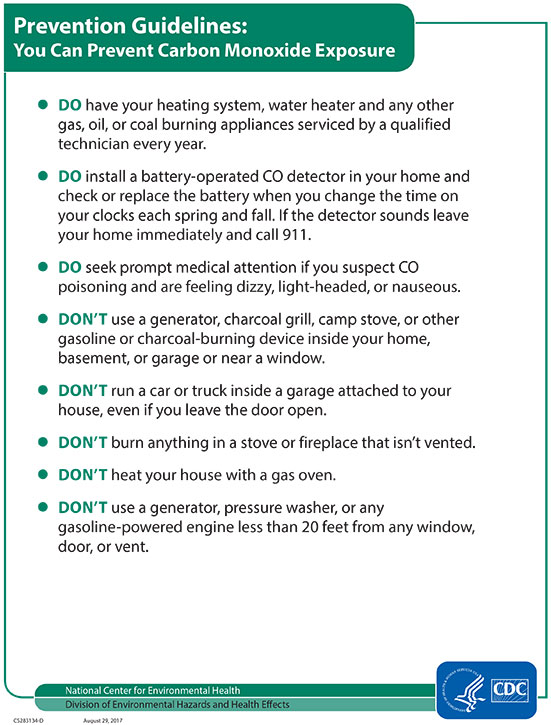
  • Change the batteries in your CO detector every six months. If you don’t have a battery-powered or battery back-up CO detector, buy one soon.
  • Have your heating system, water heater, and any other gas, oil, or coal-burning appliances serviced by a qualified technician every year.
  • Keep vents/flues and fresh air intake free of debris. Debris can block ventilation lines.
  • Never leave the motor running in a vehicle parked in an enclosed or partially enclosed space, such as a garage.
  • Never run a motor vehicle, generator, pressure washer, or any gasoline-powered engine less than 20 feet from an open window, door, or vent where exhaust can vent into an enclosed area.
  • Never use a charcoal grill, hibachi, lantern, or portable camping stove inside a home, tent, or camper.
  • Never run a generator, pressure washer, or any gasoline-powered engine inside a basement, garage, or other enclosed structure, even if the doors or windows are open.
  • If you suspect CO poisoning, call 911 or a health care professional right away.
CO poisoning is entirely preventable. You can protect yourself and your family by learning the symptoms of CO poisoning and how to prevent it.
For more information, please visit the Carbon Monoxide Poisoning website.
screenshot of guidelines pdf

Carbon Monoxide Awareness Week, Nov. 1-7, 2022.

Thursday, January 20, 2011

Home Heating Safety Alert 家用取暖安全警報

Winter Weather Warning: CPSC and USFA Issue Home Heating Safety Alert

WASHINGTON, D.C. - The U.S. Consumer Product Safety Commission (CPSC) and the United States Fire Administration (USFA) urge consumers to play it safe as winter weather blankets the United States.

According to USFA, home fires spike in winter months. Cooking and home heating are the leading causes of residential building fires during the winter. The risk of fires also increases with the use of supplemental heating, such as space heaters.

CPSC estimates that home heating was associated with an average of 33,300 fires and 180 fire deaths per year from 2005 to 2007.

Carbon monoxide (CO) is also a serious threat in the winter months. Any fuel-burning appliances in the home, including furnaces and fireplaces, are a potential CO source. Carbon monoxide is called the "invisible killer," because it is an odorless, colorless and poisonous gas.

There has been an increasing trend in unintentional, non-fire CO deaths associated with consumer products since 1999. CPSC staff estimates there were 184 CO poisoning deaths on average per year from 2005-2007 compared to 122 deaths per year from 1999-2001. Since 1999, the majority of CO deaths have been associated with heating systems and portable generators.

Smoke and carbon monoxide alarms are an important line of defence in the home, and they give consumers valuable escape time. About two-thirds of fire deaths occur in homes with no smoke alarms, or in homes where consumers have removed the alarm's batteries or where the batteries are dead. Recently, there were tragic deaths in homes where alarms could have made a difference:

In Citra, Fla., a fire killed five children on November 8. Their home did not have smoke alarms.
In Penfield, N.Y., a 54-year-old man died of CO poisoning in November. Prior to his death, the home's CO alarms reportedly beeped and were removed from the house.
CPSC and USFA recommend that in addition to having working smoke and CO alarms, consumers should follow these safety tips to prevent fires and CO poisoning:

Preventing Fires Place space heaters on a floor that is flat and level. Do not put space heaters on rugs or carpets. Keep the heater at least three feet from bedding, drapes, furniture, and other flammable materials; and place space heaters out of the flow of foot traffic. Keep children and pets away from space heaters.
To prevent the risk of fire, NEVER leave a space heater on when you go to sleep or place a space heater close to any sleeping person. Turn the heater off when you leave the area. See CPSC's electric space heater safety alert for more space heater safety tips (pdf).
Never use gasoline in a kerosene space heater. Even small amounts of gasoline mixed with kerosene can increase the risk of a fire.
Have fireplace flues and chimneys inspected for leakage and blockage from creosote or debris every year?
Open the fireplace damper before lighting a fire, and keep it open until the ashes are cool. An open damper may help prevent the build-up of poisonous gases inside the home.
Store fireplace ashes in a fire-resistant container, and cover the container with a lid. Keep the container outdoors and away from combustibles. Dispose of ashes carefully, keeping them away from dry leaves, trash or other combustible materials.

Preventing CO poisoning Schedule a yearly professional inspection of all fuel-burning home heating systems, including furnaces, boilers, fireplaces, wood stoves, water heaters, chimneys, flues and vents.
NEVER operate a portable gasoline-powered generator in an enclosed space, such as a garage, shed, or crawlspace, or in the home.
Keep portable generators as far away from your home and your neighbours' homes as possible - away from open doors, windows or vents that could allow deadly carbon monoxide into the home.
When purchasing a space heater, ask the salesperson whether the heater has been safety-certified. A certified heater will have a safety certification mark. These heaters will have the most up-to-date safety features. An unvented gas space heater that meets current safety standards will shut off if oxygen levels fall too low.
Do not use portable propane space heaters indoors or in any confined space, unless they are designed specifically for indoor use. Always follow the manufacturer's directions for proper use.
Never use gas or electric stoves to heat the home. They are not intended for that purpose and can pose a CO or fire hazard.
More information can be found in CPSC's Safety Alert, Winter warning on portable generatorReplace batteries.

Related News:
2013/12/24 CTV News - Two deaths and multiple emergency calls for carbon monoxide poisoning
2013/12/25 World Journal - 多市逾百宗一氧化碳中毒
2019-12-03 MingPao - 匹特草原商場傳6人一氧化碳中毒

Monday, January 25, 2010

New law to have Smoke Alarm in ALL homes 火警煙霧警報器

BC Fire Code require that every private home and hotel or motel room (including built before 1979) must have smoke alarms installed by May 1, 2010. For more information about this new Law you can visit the BC Government Website's Housing and Construction Standards or visit Safe at Home for the pamphlet explaing the new law.

For every household, it is better upgrade the existing smoke alarms to interconnected smoke alarm equipped with carbon monoxide alarm. Test the smoke alarms monthly by press the test buttons. The alarm will tell you for a new replacement when it is expired.

US Consumer Product Safety Commission (CPSC) estimates there was a yearly average of 386,300 residential fires resulting in nearly 2,400 deaths between 2006 and 2008. Two-thirds of fire deaths occur in homes where there are no smoke alarms or no working smoke alarms. That is why it is important to replace batteries at least once every year and to test your alarms every month to make sure they work.

US CPSC estimates there was an annual average of 183 unintentional non-fire CO poisoning deaths associated with consumer products between 2006 and 2008. CO is called the "invisible killer," because it is a colorless, odorless and poisonous gas. Because of this, people may not know they are being poisoned. Carbon monoxide is produced by the incomplete burning of fuel in various products, including furnaces, portable generators, fireplaces, cars and charcoal grills. That is why it is important to have working CO alarms in the home, on each level and outside each sleeping area.

世界新聞網-北美華人社區新聞 - 日前造成兩名女童喪命的素里民宅火警證實為一宗意外,但調查人員指屋內三個煙霧警報器(Smoke Detectors / Smoke Alarm)有兩個失效,否則悲劇或可避免。

周二清晨6時30日發生在素里市125街9400號路段的火警,造成五歲莎嘉(Sajel Saroya)與三歲的普莉亞(Priya Saroya)兩姊妹葬身火窟。警方調查後證實事件為意外,並無人為縱火跡象。

但調查人員指當時屋內的三個煙霧警報器中有兩個並未發生作用,否則住戶應有更多救人及逃生時間,這場悲劇或可避免。

素里消防局副局長卡維里亞(Jon Caviglia)表示,地下室與一樓的兩個煙霧警報器失效,但樓上的警報器則運作正常。他說鑑識人員相信起火點在一樓客廳。

The Most Overlooked Fire Hazard In Your Home 

Related news:
2009/02/02 Ming Pao - 廢氣入屋殺人兩老一死一危
2010/12/05 Sing Tao - 65%煙霧器失靈害死人 火警時應響卻不鳴 宜定期檢查
2012/01/31 Whitehorse.com - Carbon Monoxide killed five people in Whitehourse
2012/03/04 Sing Tao - 一氧化碳奪5命 肇因煙囪堵塞
2012/03/07 CPSC - Change Batteries in Smoke and CO Alarms
2013/12/24 CTV News - Two deaths and multiple emergency calls for carbon monoxide poisoning
2013/12/25 World Journal - 多市逾百宗一氧化碳中毒
2014/04/04 The Guardian - Nest halts sales of Protect smoke and carbon monoxide alarm on safety fears
2014/04/04 Toronto Sun - Google's Nest halts home alarm system sales over possible defect 
2015/07/04 Sing Tao - 防火警鐘一年3誤鳴 溫業主將罰款200
2018/03/23 Sing Tao - 无法检测烟雾!kidde全国回收4万警报器
2018/12/19 Ming Pao -  慎防一氧化碳中毒 家中應設置警報器
2019/03/20 Ming Pao - 列市府促屋主裝CO警報器 改動暖氣爐導致一氧化碳積聚 母偕年幼子女險死
2019/05/18 Ming Pao - 三文灣露營客一氧化碳中毒 一死一傷