More information on skylight:
Sunday, May 16, 2021

Friday, May 14, 2021

Friday, March 26, 2021
Power Generator Safety at home
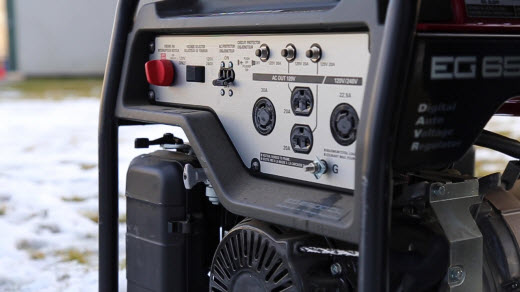
Using a Generator Safely at Home
Using a portable generator after a power outage is definitely handy, but generators can be dangerous if they’re used incorrectly. Be cautious and always follow all safety instructions provided by the manufacturer. The following are some safety tips and information about the dangers of home generators. You should consult a professional for assistance when installing a home generator and for advice with respect to your specific circumstances and generator type.
Setting up your generator
- Start by making sure the generator has all the necessary safety labels.
- Make sure the generator you purchase is rated for the power that you think you will need.
- Find a qualified electrician to install the generator in a safe location.
- Before using a generator make sure the unit is properly grounded and follow the instructions and electrical codes carefully.
- When in doubt always ask a professional.
Potential Hazards
The two main hazards to be aware of when using a generator are electrocution and carbon monoxide poisoning. Portable generators can also be fire hazards.Electrocution
- Losing power during a flood is not uncommon. However, never use a generator in a flooded basement. It’s important to keep the generator in a dry place.
- Make sure to protect the generator from rain and cover it with a canopy if necessary.
- Always operate the generator in a dry place and make sure your hands are dry.
Carbon Monoxide Poisoning
- Carbon monoxide poisoning happens when someone breaths in too much carbon monoxide, an odourless colourless gas that can be deadly.
- Be sure to keep the generator somewhere with proper ventilation.
- If the generator is outside, don’t place it close to any windows or vents because carbon monoxide can build up inside.
- Have working carbon monoxide detectors throughout your home and check the batteries frequently. If the detectors are wired to the house’s electricity supply, make sure they have battery-powered back-ups.
- The symptoms of carbon monoxide poisoning include dizziness, headaches, nausea and tiredness. If you experience any of these symptoms go outside for fresh air immediately.
Fire Hazard
- Generators become extremely hot during operation.
- Let the generator cool down and turn it off before refueling. Never refuel the generator while it’s still hot.
- Store your fuel outside in approved containers. Don’t store any fuel near a fuel-burning appliance or the generator itself.
Sunday, October 18, 2020
Ask A Home Inspector
Before The Inspection
Do not settle for the first home inspector that pops up on your Google search? Take some time to talk to the home inspectors beforehand so that you can find the best one for you. So you already have one lined up once you find a home. Here are some questions to ask before the inspection:
- What do you check?
- What do you not check?
- How long have you been an inspector?
- What do you charge?
- How long will an inspection take?
- Can I come with you?
During The Meeting
Attending your home inspection is always a good idea so that you can see what the inspector is looking at and ask any questions right away. A home inspector's report is often highly technical, and it can be hard to decipher; it is much easier if the inspector can just tell you what is wrong.
The crucial questions to ask during the home inspection:
- What does that mean?
- How big of an issue is this?
- What is that (suspected issue), and does it need to be repaired?
- What are your main concerns about the house?
After The Inspection
Now that the inspection is finished, there are a few more questions you can ask the inspector. The reports they give can look intimidating, and you may need to check with them on certain issues in the report to ensure you do not need to worry about them.
- These are some of the important questions to ask:
- Can you clarify [issue]?
- What specific problems concern you, and approximately how much will they cost to repair?
- Is there anything I will need to do immediately after I move it?
- Do I need to have another expert come in for a follow-up inspection?
Monday, August 31, 2020
What You Need to Know About Your Ceiling Fan’s Direction
A ceiling fan can help keep your home cool in the summer and warm in the winter. But did you know you should change the direction your ceiling fan spins from season to season?
Why Does It Matter Which Direction a Ceiling Fan Spins?
Ceiling fans help circulate air in your home. While most people are familiar with the cooling effect that circulating air can have during the warm-weather months, they may not realize that circulating air can help keep your home warm when the temperatures turn cool. This makes ceiling fans great to use during any time of the year.
It all depends which direction the ceiling fan rotates. Spinning it the right way at the right time can help keep everyone in your home comfortable and save money on your utility bills.
What Direction Should It Spin in Summer?
Your ceiling fan should spin counterclockwise during the summer months. This position is also known as the “forward direction.” A ceiling fan that spins counterclockwise forces air downward, providing cooling relief when it’s hot. It’s recommended to run the fan faster the hotter it gets to increase the cooling airflow.
What Direction Should It Spin in Winter?
Conversely, ceiling fan needs to spin clockwise during the winter months. This position is also known as the “reverse direction.” Because warm air rises, the air near the ceiling can be three to four degrees warmer than air near the floor. A ceiling fan that spins clockwise will draw cooler air up and force warmer air near the ceiling down and out toward walls. It’s best to run the fan on a low speed so that it doesn’t create too much of a cooling breeze.
Does It Matter Which Room You’re In?
Keep the fan direction in mind when you’re looking to cool down or warm up a room. For instance, run the fan counterclockwise if an oven heats up your kitchen beyond what’s comfortable, or body heat from a gathering of people makes a room too toasty. Conversely, run a fan clockwise to amplify the heat from a fireplace or any other heat source in a room.
How to Change the Direction of a Ceiling Fan
Most types of ceiling fans have a switch on the motor that lets you change the direction by sliding it one way or the other. You will most likely need a ladder to reach it. Always make sure your fan is turned off and completely still before getting on the ladder.
More tricked-out ceiling fans come with remote controls with buttons that let you easily and conveniently change the spin direction and speed of the fan.
Saturday, February 29, 2020
How Does a Septic Tank Work?
A well-designed, properly installed septic system can last for decades—or fail in just a few years. It’s up to you as long as you can answer how do septic systems tanks work.
Maintaining healthy septic systems isn’t all that expensive, but you could easily spend tens of thousands to dig up and replace a septic system that has totally failed. As the old saying goes, an ounce of prevention is worth a pound of cure. It’s important to learn how does a septic tank work.
Good maintenance starts with understanding how does a septic system work and how it can fail. Let’s take a look underground and see what’s supposed to happen in a well-functioning septic system. After that, I’ll show you why things go wrong and give you some pointers for keeping your system in top shape.
Understand that a septic system is a cafeteria for bacteria
Bacteria are what make a septic system work. They break down waste, leaving the water clean enough to safely percolate down into the earth. The whole system is designed to keep bacteria healthy and busy. Some live in the tank, but most do their work in the drain field.
1. All waste flows to the septic tank.
2. Watery waste, called “effluent,” fills most of the tank. Anaerobic bacteria begin breaking down the organic material in the effluent.
3. A layer of sludge falls to the bottom. Sludge is composed of inorganic solids and the byproducts of bacterial digestion.
4. A layer of scum floats to the top. Scum is primarily composed of fats, greases and oils.
2. Watery waste, called “effluent,” fills most of the tank. Anaerobic bacteria begin breaking down the organic material in the effluent.
3. A layer of sludge falls to the bottom. Sludge is composed of inorganic solids and the byproducts of bacterial digestion.
4. A layer of scum floats to the top. Scum is primarily composed of fats, greases and oils.
The septic tank acts like a settling pond. Greases and oils float to the top. Heavier solids sink to the bottom.
5. A filter prevents most solids from entering the outlet pipe.
6. Effluent flows to the drain field.
5. A filter prevents most solids from entering the outlet pipe.
6. Effluent flows to the drain field.
The drain septic field provides a large area where bacteria can thrive and treated water can seep into the ground.
7. Holes in the drain septic field pipe allow effluent to seep into surrounding gravel.
7. Holes in the drain septic field pipe allow effluent to seep into surrounding gravel.
Gravel around pipes allows water to flow into soil and oxygen to reach bacteria.
8. Aerobic bacteria in gravel and soil complete decomposition of the waste.
9. Clean water seeps down into the groundwater and aquifer.
8. Aerobic bacteria in gravel and soil complete decomposition of the waste.
9. Clean water seeps down into the groundwater and aquifer.
Septic Tank Clean Out: Don’t abuse the system
A septic system that was properly designed and installed needs only occasional ‘pumping’ to remove the sludge and scum from the tank. But without knowing how does a septic tank work, you can do things that harm—or destroy—the system.
- Waste that decomposes slowly (or not at all) gets flushed down drains. Cigarette butts, diapers and coffee grounds often cause problems.
- If used heavily, garbage disposers can send too much solid waste into the system.
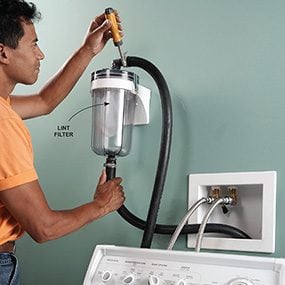
- Lint from synthetic fibers flows from washing machines. Bacteria in the tank and drain septic field can’t break it down.
- Household chemicals like disinfecting cleaners and antibacterial soaps kill bacteria. Most systems can handle light use of these products, but the less you use them, the better.
- Too much wastewater over a short period of time flushes out the tank too rapidly.
- Too much sludge reduces bacteria’s ability to break down waste. Excess sludge can also overflow into the drain field.
- Sludge or scum plugs holes in the pipe.
- Roots from trees and shrubs can clog and damage a drain field.
- Compacted soil and gravel block seepage of effluent and deprive bacteria of oxygen. This is often caused by cars driving or parking on the drain field.
Get your tank pumped…
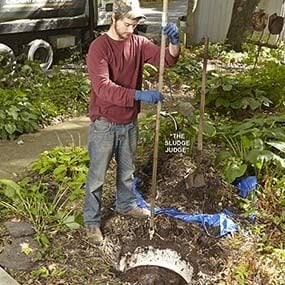
Pumping removes the buildup of sludge and scum, which slows down bacterial action in the tank. Your tank may need pumping each year, but it’s possible to go two or three years between pumpings, depending on the size of your tank and the amount of waste you run through the system. Ask your inspector to make a rough recommendation for how often your tank should be pumped.
…but don’t hire a pumper until you need it
>

Install an effluent filter in your septic system
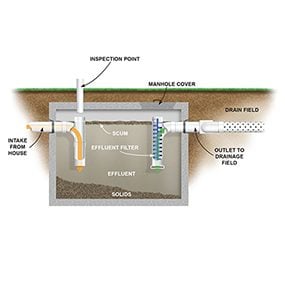
Ask your contractor to install an effluent filter on the outflow pipe on your tank. (It will probably cost $50 to $100, plus labor.) This device helps prevent solids from entering the drain field and will need to be cleaned out on occasion by a contractor.
Solution for a clogged septic system
If your septic system becomes clogged and you frequently have to clean the filter, you might be tempted to simply remove it. Keep it. Septic tanks work by allowing waste to separate into three layers: solids, effluent and scum (see illustration above). The solids settle to the bottom, where microorganisms decompose them. The scum, composed of waste that’s lighter than water, floats on top. The middle layer of effluent exits the tank and travels through underground perforated pipes into the drainage field. There, gravel and soil act as biological filters to purify the wastewater as it sinks into the ground (see illustration above).
Your state health code requires an effluent filter, so keep it in place. (Not all regional codes require this filter.) Besides, removing the filter could create a far worse (and expensive) problem. Without the filter, waste particles could pass into the perforated pipes and clog them. It would require extensive digging to clean and unclog the system.
However, your filter should not need semiannual cleaning. Most filters don’t have to be cleaned until the tank is pumped, which is typically every two to five years. Chances are you’re putting filter-clogging materials down your drain, such as grease, fat or food scraps.
The use of a food disposer is a common mistake. A disposer won’t break down food particles enough to allow them to pass through the septic tank filter. It can increase the amount of solids in the septic tank by as much as 50 percent. Flushing plastic materials, disposable diapers, paper towels, nonbiodegradable products and tobacco will also clog the system.
For more details on what not to put down your drain, call your state health department. Read more on filtering out troublesome laundry lint.
Get an inspection
A thorough initial inspection by a pro will cost $300 to $500; after that, regular inspections cost less than $100 each. Your pro will be able to tell you how often your system should be inspected and how does a septic tank work.
Simple as a septic system may seem, evaluating its health really requires an expert. There are plenty of contractors who will gladly pump the sludge out of your tank, but in my experience many can’t fully answer how does a septic system work or how it should be maintained. I highly recommend looking for a contractor who has received some formal training in the science of septic systems. Some states have adopted certification programs for septic contractors—check with your Secretary of State’s office to see if yours is among them.
A complete inspection will determine whether your system is up to code (many are not) and the condition of the tank and drain field. A good inspector will also be able to tell you whether your tank is large enough for your household, and the maximum volume of water you can pass through it in a day.
You may be able to improve the performance of your system by adding bacteria with a product such as RID-X. Your pro should be able to tell you if your system will benefit from this treatment as you discover how does a septic tank work.
Alternatives to a new drain field
If an inspection or sewage backup reveals that your drain field is in trouble, the ultimate solution is to replace it. The cost can be huge, however, so it’s worth discussing other options with a contractor.
- Clean the pipes. A contractor can clear out the drain septic field pipes with a rotary pressure washer. “Jetting” the pipes usually costs about $200.
- Treat the system with chemicals. Ask your contractor about treating your system with a commercial product (not a homemade one) that increases the amount of oxygen in the drain field. I recommend Septic-Scrub. A typical treatment costs $500 to $1,000.
- Loosen the soil. In states where it’s legal, some contractors can fracture compacted soil around the pipes by injecting high-pressure air in numerous locations around the drain field, a process called “terra-lifting.” Depending on the situation, this can cost less than $1,000 or more than $4,000.
Protect your drain septic field from lint
Don’t overload the septic system
Limit your water use. Reducing the amount of water that runs into your tank, particularly over a short period of time, will prevent the flushing of untreated waste into your drain field. You can replace old toilets with low-flow models, install reduced-flow showerheads, and simplest of all, wash laundry throughout the week rather than just on Saturday morning.
Wednesday, January 22, 2020
Carbon Monoxide (CO) Poisoning Prevention
Carbon Monoxide Awareness Week, Nov. 1-7, 2022.
How to Recognize CO Poisoning
The most common symptoms of CO poisoning are headache, dizziness, weakness, nausea, vomiting, chest pain, and confusion. People who are sleeping or who have been drinking alcohol can die from CO poisoning before ever having symptoms.
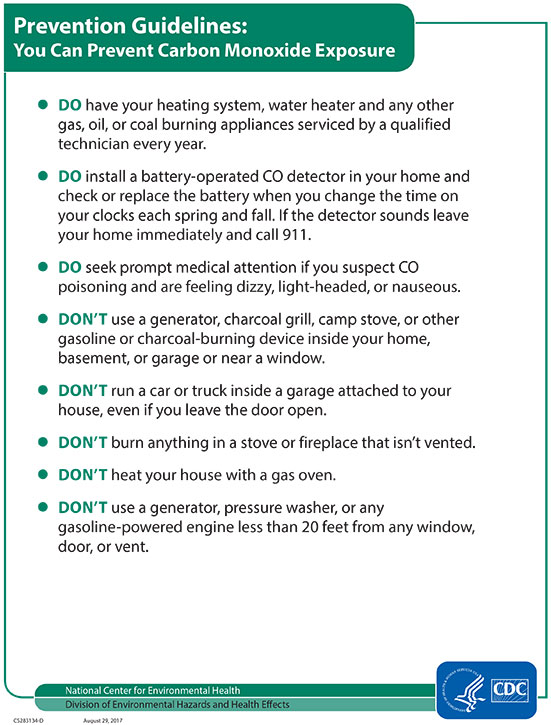
CO Poisoning Prevention Tips
- Change the batteries in your CO detector every six months. If you don’t have a battery-powered or battery back-up CO detector, buy one soon.
- Have your heating system, water heater, and any other gas, oil, or coal-burning appliances serviced by a qualified technician every year.
- Keep vents/flues and fresh air intake free of debris. Debris can block ventilation lines.
- Never leave the motor running in a vehicle parked in an enclosed or partially enclosed space, such as a garage.
- Never run a motor vehicle, generator, pressure washer, or any gasoline-powered engine less than 20 feet from an open window, door, or vent where exhaust can vent into an enclosed area.
- Never use a charcoal grill, hibachi, lantern, or portable camping stove inside a home, tent, or camper.
- Never run a generator, pressure washer, or any gasoline-powered engine inside a basement, garage, or other enclosed structure, even if the doors or windows are open.
- If you suspect CO poisoning, call 911 or a health care professional right away.

CO poisoning is entirely preventable. You can protect yourself and your family by learning the symptoms of CO poisoning and how to prevent it.
For more information, please visit the Carbon Monoxide Poisoning website.
Carbon Monoxide Awareness Week, Nov. 1-7, 2022.
Subscribe to:
Posts (Atom)